
So, your business has a website. It’s up, the lights are on, but how do you know it’s positively impacting your marketing efforts? What looks good may not drive the best results.
When it comes to website performance, here are 5 reasons why you should set aside budget for semi-annual or annual health checks.
01Protect your investment
New website projects are expensive. There’s no disagreeing with our clients about that. It’s the approach many take beyond that project that usually raises an eyebrow or two. Once the initial investment is made, many businesses leave the website to fend for itself.
Some companies set aside funds for base website maintenance and others for general reactive support budgets. But few allocate resources for performance health checks.
Websites need regular assessments to ensure everything is working properly. You’ll be able to identify issues before they become serious and costly. This proactive approach will ensure your initial investment is protected and save you money in the end.
02Extend your website’s lifecycle
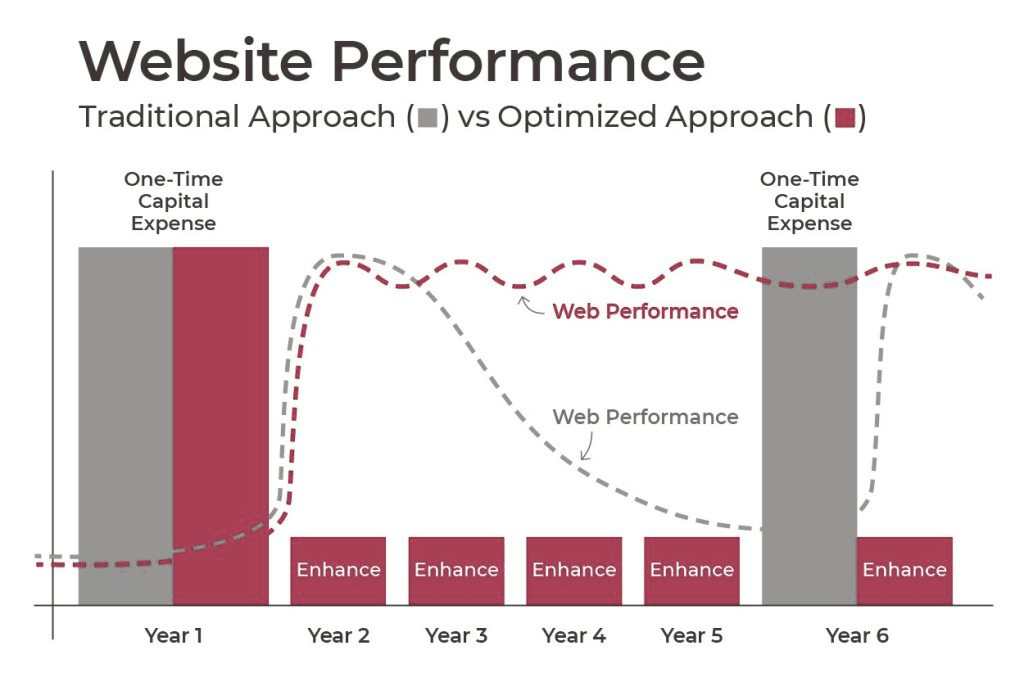
After the launch of a website, web traffic and engagement metrics are often boosted as users spend time navigating the new pages. Review metrics 12 months later, and those trends have likely fallen away. Search engine benchmarks are continuously evolving as new features and capabilities become available. Even as early as 12 months into a website’s lifecycle, the initial investment is already starting to weaken relative to newer websites as they become more competitive in search.
Refreshing user journey paths on your website can significantly extend its shelf life from a 4–5-year cycle to an 8–10-year cycle. This idea is often dismissed as people calculate, for example, that $50K to build + $50K in updates means they could have built the website twice.
What this logic fails to consider are the other important benefits of ongoing investment to evolve and enhance your website. These often-unaccounted benefits are improved user experience, sustained performance in search, and conversion rates that remain optimized through the duration of the product.
03Performance algorithms are constantly changing
Performance scores fall over time as technology and competition evolve. If you optimized your website last year, it’s no guarantee of good performance this year. Search engines set the rules and standards for all businesses that rely on their services to produce a steady stream of organic web traffic. Adherence to these standards can lead to preferential search engine results page (SERP) rankings.
Search engines are continually evolving their algorithms to improve user experience and maximize advertising effectiveness. In the darkness of the pandemic, Google flipped their performance algorithm to a user-experience-first calculation, heavily favouring mobile users, whose market share continues to grow, at the expense of traditional laptop/desktop audiences.
As these new benchmarks roll out, search engines continue to seek ways to separate businesses in their results listings. Scheduling a routine health check will help you see through the noise and determine where to prioritize your effort.
You can assume if you don’t know your performance metrics, they are working against you.
04Free website performance reports won’t cut it
We frequently see the “free report” scenario, still commonly used by marketing teams, to assess website performance. While these reports can provide a general indication of performance, they rarely provide a practical direction marketers can use to make effective decisions and plan budgets.
We often chuckle to ourselves — forgive us, we spend our days at the production end of delivering tangible solutions to our clients — as we read through reports that recommend “minimize javascript” as the number one item to tackle in a list hundreds of jargon-filled items long.
We help convert these reports into meaningful, value-prioritized actions. For some businesses, minimizing javascript will be part of the solution. For most, it will simply be cleaning up the use of integrations and plugins to optimize the business’s current requirements (let’s not put budget towards optimizing technology not required for performance).
If you have engaged in a website rebuild project in recent years, some website performance tools may be familiar to you, such as Google’s Lighthouse scanner, the PageSpeed Insights web tool, and search engine support tools like Google Search Console. But the skill required to put these tools to use lies in breaking down the terminology, associating issues with the relevant pages and components that make up your website, and then finding practical ways to implement solutions.
05Identify value & prioritize
Trying to get up to speed with the technical know-how for everything required to maximize website performance can be overwhelming, particularly for small marketing teams. Understanding what areas to focus on and determining how to practically achieve them is more complex than ever before.
Free reports only provide overview insights. You need a tangible, actionable list of activities to prioritize and make the most use of your valuable budget.
A health check report provides you with direction to engage your internal teams or agency with remediation actions that will directly improve your performance metrics and overall results.
It’s a great time to schedule a health check.
We’ve seen countless case studies supporting the benefits of specific web performance, whether it be page load speed, accessibility, search engine optimization (SEO), user experience (UX) and/or user interface (UI). As a marketer, you’re left trying to decide which area to focus on, with each being flagged as the most important.
So where do you turn? At TMD, we provide our clients balanced advice to help maximize budgets and see real performance. We go beyond checking your website’s vitals and prioritize based on the bigger picture of your business.